Is It Too Late To Say Sorry?
ב"ה

The Chabad of Sugar Land Weekly Newsletter

Icon
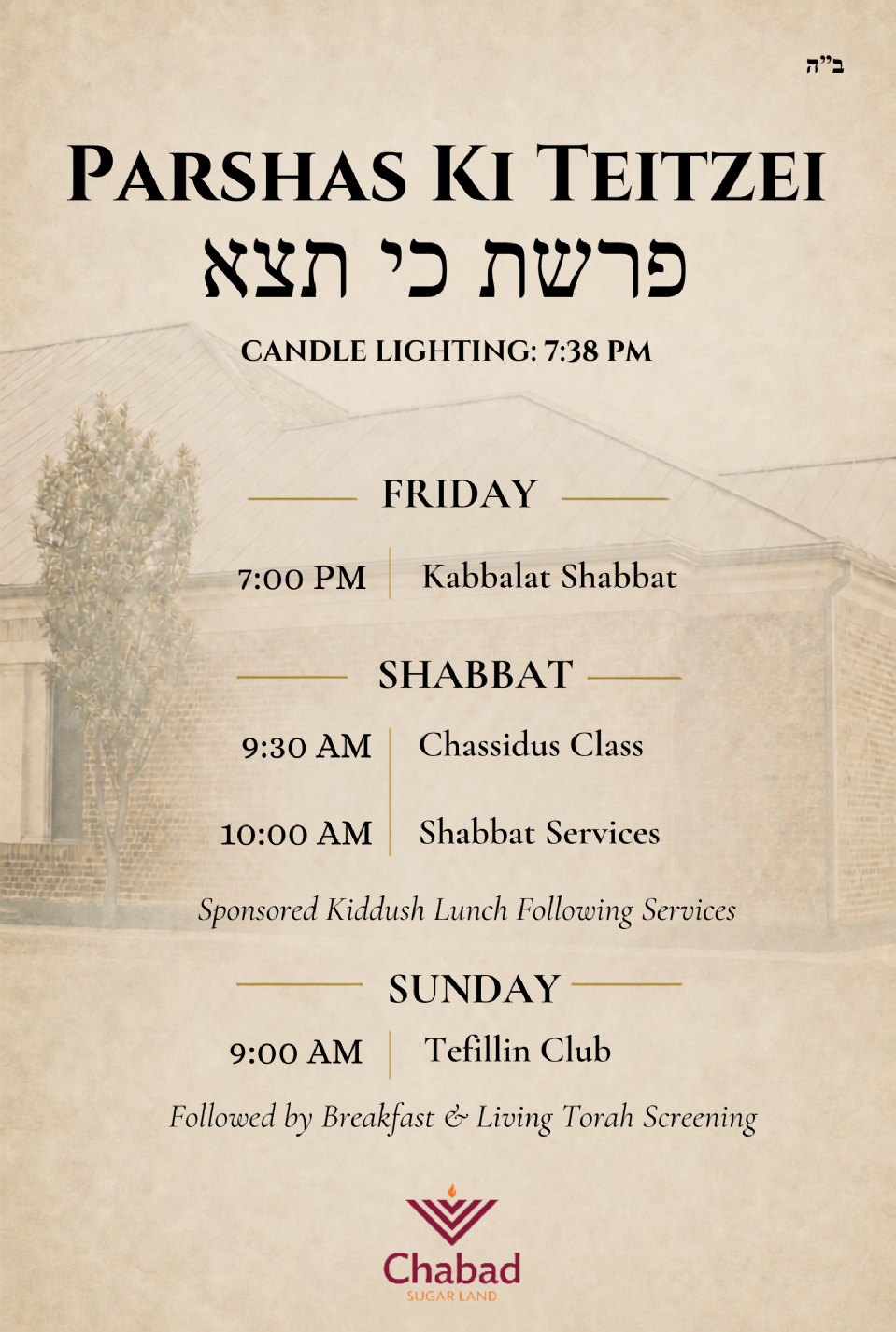
Candle Lighting Times for
Sugar Land, Texas:
Friday, Aug. 21
7:38 pm

Message from the Rabbi

Dear Friends,

Some people prefer sweet foods, others savory. Our tastes may be different, but a healthy diet requires variety. Eating only what we naturally enjoy can leave us unbalanced and overly dependent on one kind of nourishment.

This idea offers an interesting lesson from this week’s Torah portion, Ki Teitzei. The portion contains the commandment to remember what Amalek did to the Jewish people after the Exodus, when they attacked a vulnerable nation without provocation. We are commanded not only to remember the event, but to carry its lesson with us.

The Midrash connects this commandment with another type of “remembering”: remembering Shabbat. These two commandments seem completely different. Shabbat is about holiness and rest, while remembering Amalek reminds us of cruelty and evil. The Midrash compares them to wine and vinegar. Both come from grapes, but they serve completely different purposes.

Jewish life contains many different kinds of mitzvot. Some feel natural and inspiring to us, while others may seem less meaningful or even uncomfortable. Yet every mitzvah comes from the same source and has its own purpose.

Judaism doesn't expect everyone to have the same spiritual taste; we each connect to different aspects of Jewish life. But just as a healthy diet requires variety, a healthy Jewish life requires us to engage with the full range of Torah and mitzvot.

The mitzvah that feels least natural to us may be precisely the one that helps us grow. By stepping beyond our preferences and embracing the entire spectrum of Jewish life, we create a deeper and more complete connection with G-d.

Shabbat shalom,


Service Times:


Click here for the Weekly Encounter with the Rebbe story!

Weekly Parsha Video

Parshat Ki Teitzei: From Inner Struggles to Inner Strength


Art by Sefira Lightstone


A well-to-do businessman once arrived in Vienna and dispatched his servant to purchase some mead (“honey wine”) from a local, Jewish-owned tavern.


He returned with a bottle, which the merchant enjoyed so much that he sent his servant out again the next day to get ten bottles of the same vintage.


The servant returned empty-handed this time, saying that the owner refused to sell him any. The businessman sent him back with even more money, but the servant returned without a single bottle for his efforts.

The merchant decided to visit the tavern himself to see why there was no more mead for sale.


When he arrived, he saw a large crowd of diners reciting the Grace After Meals. When they concluded, the tavern-keeper told the merchant that his mead supply was exhausted.

The merchant asked when some more would be available, to which the owner answered that it would never be available again. Seeing the visitor’s amazement, he explained:


When we were young, my wife was a midwife and I was a mohel (ritual circumciser). I would officiate at every circumcision that came my way, even if it was a long distance from home, relishing the opportunity to bring another Jewish boy into the covenant of Abraham.


Once, on the day before Yom Kippur, a simple villager came to tell me that his wife had given birth to a boy eight days earlier, and he needed me to perform the circumcision that day. Upon learning that he lived quite a distance away, I requested that he hire a coach for the trip. He refused, claiming he had no money.

I was committed, and we started off on foot together. The villager quickly outpaced me, and by the time I arrived at his home, he had already gone to work, and only the mother and the baby were home.


Now, to perform the circumcision, I needed someone to act as sandek—the one who holds the baby during the procedure. So I stood outside the humble home, hoping to find someone to fill the role.


Finally, I spotted a man hurrying past. I ran up to him and asked that he serve as  sandek. He refused, saying that he was busy running from one synagogue to the next, collecting alms. Having no choice, I asked him how much he expected to net that day and made a deal with him: If he would be the sandek, he could follow me home and I would give him that amount!


The beggar agreed.


After the circumcision, we both hurried to my home with barely enough time to eat and prepare for Yom Kippur.


My family was very relieved to see me back, and I gave my last few coins to the man, expecting him to be on his way.

But he was in no hurry, insisting that I first pour him a drink. Eager to move on with the day, I indulged him and opened a fresh keg of mead.


After taking a deep draft, he wished me lechaim (“to life”) and blessed me that the barrel would not run out until the final feast celebrating my youngest son’s wedding.


And so it was. Over the years, I have prospered from selling this never-ending supply of high-quality mead.


But just now, thank G‑d, we concluded the last of the seven days of celebration for my youngest son’s marriage, and the mead just ran dry!


“A person should pay strong attention and make great efforts to uphold that which the Creator has obligated him to do as part of his service to Him to fulfill His mitzvot and to refrain from that which He has exhorted us not to do, in accordance with His requests. For then the Creator will agree to bestow on him the things for which he relies on Him.”
--Shaar Habitachon, Chapter 3, Kehot Edition, Page 76.


A Daily Dose of Halachah

The new Daily Halacha Group is where a brief daily voice note - about one minute long - is shared by Rabbi Feigenson, highlighting a practical Jewish law.

The group has now begun learning the laws of Rosh Hashanah, offering a meaningful and accessible way to prepare for the upcoming holiday.

The project was started in memory of his father, Rabbi Peretz Feigenson OBM, who asked in his will that his children study one short section of Jewish law each day.

Join the Daily Halacha group and add one meaningful minute of Torah learning to your day.

Click here to join: https://chat.whatsapp.com/GUi3R2P5cOg1KsNQV4JrPm


Ask The Rabbi: Weekly Q&A


Question:

I have something weighing on my conscience. I said very hurtful words to a friend some years ago and I never apologized. We drifted and went our separate ways, but I always felt bad about it, and decided that next time we see each other I'm going to own up to my wrongdoing.

Sadly, that friend died last week and I never had the chance to apologize. I know it's too late but is there anything I can do about it?


Answer:

It is very painful to hold on to guilt for years. It is even more painful to think that you may have to hold on to that guilt for the rest of your life.


But the truth is you don't.

While it is preferable to make amends with someone we have wronged to their face and in their lifetime, it is still possible to do so after their death.


Jewish law stipulates a specific procedure for asking forgiveness from the departed:

Go to the grave of the one you hurt, along with ten other people. 

Humbly remove your shoes and say out loud:

 "I have sinned before the G-d of Israel, and before [name of the departed] whom I have wronged." 


You don't need to go into graphic detail, but you do need to expressly state the wrong you’ve done, unless that would be disrespectful to the dead. 


Then, the ten people present say, "You are forgiven. You are forgiven. You are forgiven." 


And you are.


You may ask: how do we know the departed forgives? How can ten other people speak on behalf of the dead? Maybe they don’t agree?


Not possible. If your apology is sincere, it will be accepted. Your friend is now in the world of truth. In that world there is no pettiness, small-mindedness, vindictiveness, or cruelty.

In heaven there is no room to hold a grudge. 


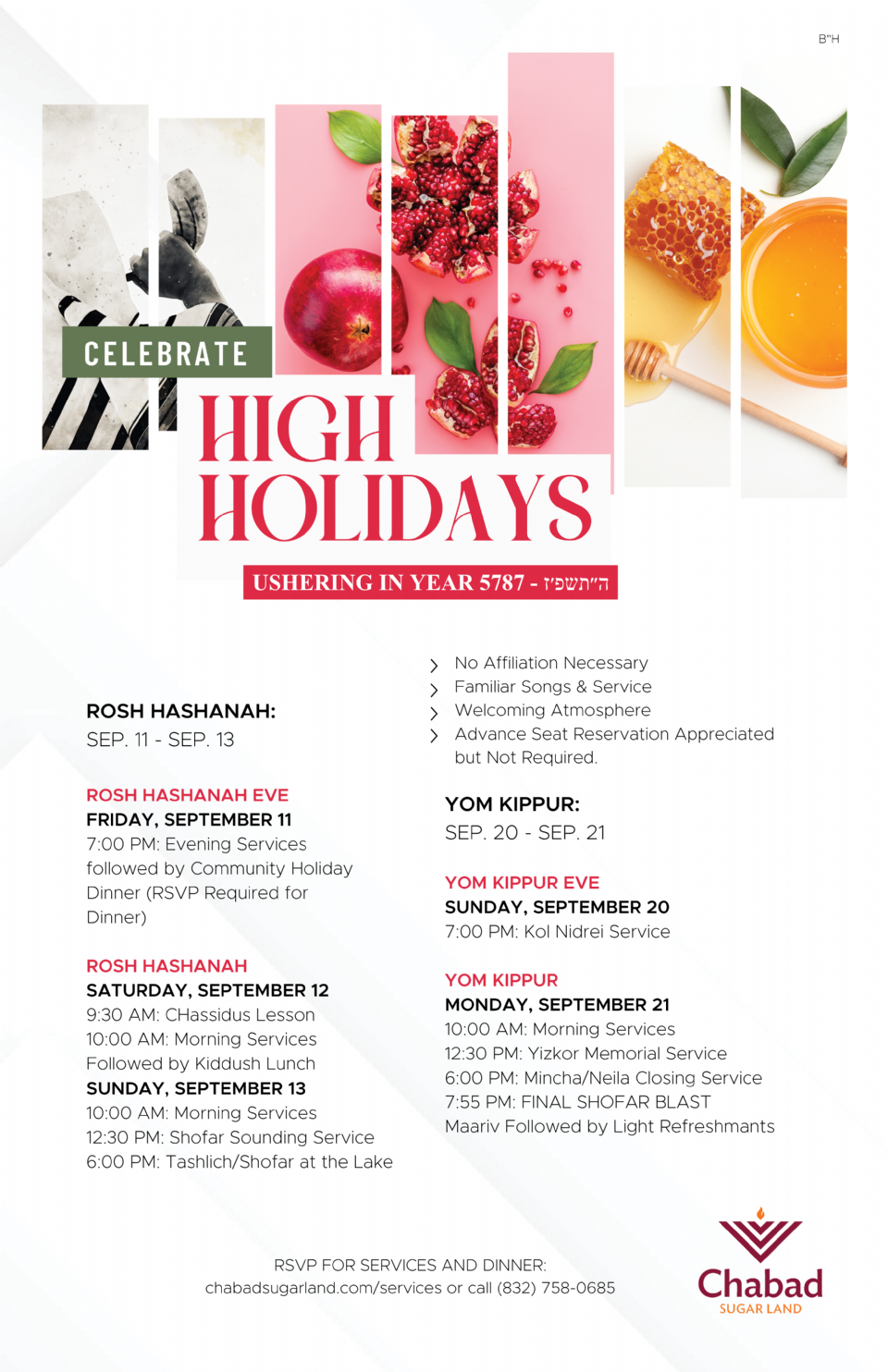
Yom Kippur is approaching. It's the right time to give and ask for forgiveness.


Our Father in Heaven is always ready to forgive.

Your friend in heaven will too. 


Good Shabbos,
Rabbi Moss


Sources
Talmud Yoma 87a
Shulchan Aruch 606:2 
Shulchan Aruch Harav 606:5 
Aruch Hashulchan 606:4
Kitzur Shulchan Aruch 131:5 


Parsha Riddle!


Parshah Riddle:

Parshat Ki Teitzei has the most Mitzvot out of any other Parsha!

How many Mitzvot are there in this weeks Parsha?


Answer to last week's riddle:

Prohibition to cut down fruit trees.

Latest from www.ChabadSugarland.com

  
By the Numbers
14 Biblical Bad Guys
Scattered throughout the Bible are a host of shady characters and outright villains who played their own key roles in shaping our story.
  
Your Questions
Why Is a Tallit So Often (Mostly) White?
the overwhelming majority of tallits have historically been white, often with stripes. There are a number of reasons for this.
  
Freeman Files
A Soul, Murdered and Alive
Call out from the depths of your heart, and the depths of heaven ring.
  
Podcasts
A Secret Mission From My Neighbor, the Rebbe
A fatal car accident, infidelity, and a kind rebbetzin catapulted Hensha from Ohio to Chasidic Brooklyn, where she married a widower with five children and settled across the street from the Rebbe.

Parshah in a Nutshell


Parshat Ki Teitzei

The name of the Parshah, "Ki Teitzei," means "when you go out," and it is found in Deuteronomy 21:10.

Seventy-four of the Torah’s 613 commandments ( mitzvot) are in the Parshah of Ki Teitzei. These include the laws of the beautiful captive, the inheritance rights of the firstborn, the wayward and rebellious son, burial and dignity of the dead, returning a lost object, sending away the mother bird before taking her young, the duty to erect a safety fence around the roof of one’s home, and the various forms of kilayim (forbidden plant and animal hybrids).

Also recounted are the judicial procedures and penalties for adultery, for the rape or seduction of an unmarried girl, and for a husband who falsely accuses his wife of infidelity. The following cannot marry a person of Jewish lineage: a mamzer (someone born from an adulterous or incestuous relationship); a male of Moabite or Ammonite descent; a first- or second-generation Edomite or Egyptian.

Our Parshah also includes laws governing the purity of the military camp; the prohibition against turning in an escaped slave; the duty to pay a worker on time, and to allow anyone working for you—man or animal—to “eat on the job”; the proper treatment of a debtor, and the prohibition against charging interest on a loan; the laws of divorce (from which are also derived many of the laws of marriage); the penalty of thirty-nine lashes for transgression of a Torah prohibition; and the procedures for yibbum (“levirate marriage”) of the wife of a deceased childless brother, or chalitzah (“removing of the shoe”) in the case that the brother-in-law does not wish to marry her.

Ki Teitzei concludes with the obligation to remember “what Amalek did to you on the road, on your way out of Egypt.”

Learn: Ki Teitzei in Depth
Browse: Ki Teitzei Parshah Columnists
Prep: Devar Torah Q&A for Ki Teitzei
Read: Haftarah in a Nutshell
Play: Ki Teitzei Parshah Quiz


Today's Quote

You ask how you can be connected with me when I do not know you personally... The true bond is created by Torah learning. When you study my teachings, read my talks and associate with those dear to me -- the chassidic community and the yeshivah students -- in their studies and farbrengens (gatherings), and you fulfill my request regarding reciting tehillim and observing Torah-study times -- in this is the bond.
— Rabbi Yosef Yitzchak of Lubavitch (quoted in Hayom Yom for Sivan 24)

Chabad World News